
Official sources checked: 28 October 2026 | By Samuel Uzochukwu Agbaraji.
A scholarship worth £9,000 sounds substantial when you are preparing for university. Yet that figure does not tell you whether your course qualifies, which academic years receive funding or when the money will reach you. For an engineering student facing rent, travel and equipment costs, those details matter more than the headline.
IGEM offers three separate scholarship routes for eligible engineering students. Your study stage determines which route to check, and each has its own entry requirements and funding limit.
This guide uses IGEM’s published criteria and the application form revised in March 2026, then goes further. You will learn how to test your eligibility before writing, check the accreditation of your precise course, compare award years with the real cost of a degree and gather convincing evidence from coursework or projects. The sample students and budgets are fictional teaching examples, not IGEM award decisions.
Application status, 10 October 2026: IGEM has announced its 2026 scholarship recipients, and the normal 2026 application period has passed. Its official scholarships and grants page says applications usually open in mid-March and close on 31 May. A separate 2027 opening notice and deadline have not been confirmed in the sources checked. Use the annual pattern to prepare, not as a promise that the next round will run on identical dates.
IGEM Scholarship at a Glance (Current Published Criteria)
Before doing anything else, identify your study position. A student holding an offer for a first degree has a different route from someone already in the first or second year. An applicant who has completed a bachelor’s degree and wants a separate master’s degree must satisfy the postgraduate rules.
| IGEM route | Who it is designed for | Maximum published full-time support | Membership requirement |
|---|---|---|---|
| Prospective undergraduate | Applicant with a conditional or unconditional offer for an Engineering Council-accredited undergraduate degree starting in the next academic session | £3,000 a year for up to three years, £9,000 in total | Already a member or join after beginning the course |
| Current undergraduate | First- or second-year student on an accredited degree, progressing at 2:1 standard or above | £3,000 a year for up to two years, £6,000 in total | Must be a member when applying |
| Prospective postgraduate | Applicant holding an offer for an accredited master’s, with an eligible accredited engineering undergraduate degree at first-class or 2:1 standard, achieved or expected | Up to £6,500 | Must be a member when applying |
Integrated MEng note: The table does not establish a separate MEng scholarship route. IGEM describes current-undergraduate support at BEng-degree level and excludes industrial years, although a 2026 undergraduate recipient was studying an MEng. The MEng explanation below covers why applicants should check their exact course.
IGEM says eligible part-time awards are pro rata, which means adjusted for the study pattern. The public information does not supply a universal part-time calculation. For the postgraduate route, it describes part-time study lasting up to two years. Request confirmation for your actual programme rather than dividing a headline award by an arbitrary number.
These maxima do not mean every applicant receives the full amount. IGEM assesses applications through its Scholarships, Grants and Awards Panel, and successful applicants receive an individual offer explaining their funding and conditions. The published material does not establish a fixed number of awards or an acceptance rate.
When Will IGEM Scholarship Applications Open for 2027?
IGEM’s published timetable gives students a useful preparation window. Under its current general guidance, applications open around mid-March and close on 31 May each year. The application form linked from its website also describes interviews in July.
However, an annual timetable is not the same as a new application announcement. As of the date of this review, IGEM had published its 2026 scholarship recipients, but the checked sources did not separately confirm a 2027 intake. Avoid social media posts that present 31 May 2027 as an officially announced deadline unless IGEM publishes that date for the new round.
A preparation calendar you can actually use
| When to prepare | Sensible action | Why it matters |
|---|---|---|
| Before the next opening | Check your exact course, intake year and membership position | These are potential eligibility barriers |
| January to February 2027 | Identify referees and collect verified project examples | People and documents can take time to organise |
| When IGEM announces the new round | Read the new application form and note the actual deadline | Forms, limits and interview arrangements can change |
| Before the announced deadline | Send the completed application and confirm that references reached IGEM | Your own submission does not automatically complete a referee’s task |
| If shortlisted | Prepare to explain your work and why it relates to engineering and the energy sector | The panel asks applicants to discuss their application |
This is Scholarmake’s suggested preparation timetable, not an official 2027 IGEM schedule. The current form says applicants should receive an acknowledgement; if none arrives within seven working days, they should follow up with IGEM.
Which IGEM Scholarship Can You Apply For?
The most useful starting point is a short eligibility audit. Answer the questions in order and stop when a compulsory condition does not fit.
Prospective undergraduate: you have an offer but have not started
This route is for a student who has a conditional or unconditional university offer for an Engineering Council-accredited undergraduate engineering degree and intends to start during the next academic session. IGEM says applicants may already be members or join after the course begins. Employees of IGEM cannot apply.
A prospective student with an offer for a general science degree should not assume that an engineering-related module makes the whole course eligible. The exact accredited programme matters. Equally, a university accepting you does not confirm that IGEM will accept your scholarship application.
Current undergraduate: you are already studying
The current undergraduate route requires enrolment in the first or second year of an accredited engineering degree, or the equivalent point in part-time study. Applicants must demonstrate progress at 2:1 standard or above and hold IGEM membership when applying. An existing IGEM undergraduate scholarship holder cannot apply again for the same award.
The published maximum is £3,000 a year for up to two years of eligible full-time study. IGEM describes this as BEng degree-level support and excludes industrial years. Do not add a placement year to your award forecast merely because the placement appears on your course timetable.
Prospective postgraduate: a new master’s, not one already started
For the separate master’s route, IGEM requires an offer for an accredited master’s degree and an eligible accredited undergraduate engineering degree with a first-class or 2:1 result, achieved or expected. Applicants must already hold IGEM membership and plan to begin the master’s in the next academic session. The public rules state that someone who has already begun that master’s cannot apply to fund it retrospectively.
Suppose a fictional graduate started an MSc in September 2026. Discovering IGEM’s postgraduate scholarship in October 2026 does not create a route to apply next spring for that same already-started course under the published rules. The more sensible step is to investigate other university support, rather than spend weeks preparing a form that conflicts with a compulsory condition.
Three sample eligibility decisions
| Fictional student | Situation | First conclusion |
|---|---|---|
| Aisha | Holds an offer to begin an accredited BEng in the next academic year | Check prospective undergraduate conditions |
| Daniel | In second year of an accredited engineering degree with results at 2:1 level; already an IGEM member | Check current undergraduate conditions, including future funded years |
| Priya | Has an accredited engineering degree and a new accredited MSc offer but has not joined IGEM | Resolve membership before a prospective postgraduate application |
These are screening examples, not confirmations of eligibility. A student with an uncertain accreditation record, different academic structure or overseas qualification should ask IGEM rather than guess.
How to Check Whether Your Engineering Course Is Accredited
This is one of the highest-value checks a student can complete before writing an application. An institution may have an excellent reputation without every course, campus or intake holding the relevant accreditation. IGEM points applicants to the Engineering Council course search.
Compare the database record with your university offer or enrolment record. In particular, check the course title, award (such as BEng, MEng or MSc), entry year, campus or delivery location and any conditions attached to the accreditation. The Engineering Council explains that accreditation normally relates to the recorded programme and intake rather than automatically covering every similarly named course.
An accreditation check that takes the guesswork out
| What to check | Example of the evidence to compare |
|---|---|
| Course name | The title on your offer compared with the database listing |
| Qualification | BEng, integrated MEng or separate MSc |
| Entry year | Whether the accredited period covers when you actually enrolled |
| Location | Whether the accreditation record includes your campus |
| Notes | Any special pathway, condition or additional qualification requirement |
Save the record or note its details and the date checked. If the university website says the programme is accredited but the database does not show your intake, contact the department and relevant accrediting professional institution. Do not silently substitute a different course record.
A Real Example: Cardiff University Mechanical Engineering
Cardiff University offers a three-year Mechanical Engineering BEng degree (UCAS code H300). The Engineering Council’s official database lists the course under reference 3342. Its full-time BEng (Hons) accreditation covers the September 2027 intake.
A student considering this course should compare the university offer with the Engineering Council’s course search, checking the course name, qualification, entry year and study mode.
This confirms that the course has a relevant accreditation record. However, accreditation alone does not guarantee eligibility for an IGEM scholarship. Applicants must still satisfy IGEM’s other requirements.
What about an integrated MEng and a year in industry?
An integrated MEng normally forms part of an undergraduate-entry programme; it is not the same application as a separate postgraduate MSc. IGEM describes current-undergraduate support at BEng-degree level and excludes industrial years. However, its 2026 recipients announcement identifies an undergraduate recipient studying an integrated MEng. That example does not establish a general MEng funding rule.
That announcement shows why you should ask about your specific course and route. It does not prove that every MEng arrangement qualifies or that an industrial placement receives funding. Ask IGEM which academic years it would count and what happens when an industrial year interrupts taught study.
What if your earlier qualification is from outside the UK?
The general scholarship page does not publish a blanket nationality exclusion. Nevertheless, the course-accreditation wording remains important. An overseas degree being academically respected does not automatically establish that it meets IGEM’s specific Engineering Council accreditation requirement. For a postgraduate applicant, both the earlier engineering qualification and proposed master’s need checking.
A focused enquiry is more productive than a long personal history. You can write to funding@igem.org.uk explaining your degree title, institution, country, year, intended course, offer and membership position. Ask whether those qualifications satisfy the stated scholarship route. Do not send identity documents unless IGEM requests them through an official process.
Is the IGEM Scholarship Fully Funded?
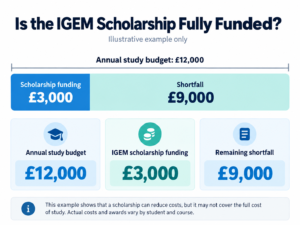
This hypothetical example shows how a £3,000 IGEM undergraduate scholarship could reduce an annual study budget of £12,000, leaving £9,000 for the student to cover through other funding sources. The example highlights why applicants should plan for tuition fees, accommodation, transport and other expenses rather than assuming a scholarship will cover everything. Actual costs vary, and scholarship awards are subject to eligibility and selection.
IGEM Scholarship is not fully funded. The published awards are capped contributions to eligible study, not a general promise to pay every tuition and living expense. IGEM’s main page states maximum scholarship values, while its current application form explains that a successful candidate receives an offer with the actual agreed amount.
That distinction matters. A student may face tuition, rent, professional membership, transport, equipment, food and course-related costs. A £3,000 award can substantially reduce pressure without making a £15,000 annual budget disappear.
Work out the real annual gap
Take a fictional undergraduate with £9,250 annual tuition and £9,000 in living and study costs. Total annual costs are £18,250. If the student eventually receives the full £3,000 scholarship for that year, the remaining amount is £15,250 before any confirmed student finance, other scholarships or savings.
| Illustrative item | Annual amount |
|---|---|
| Tuition | £9,250 |
| Accommodation, food, travel and materials | £9,000 |
| Total cost | £18,250 |
| IGEM award, if full £3,000 is offered for that year | −£3,000 |
| Still to finance before other support | £15,250 |
These are invented amounts for teaching the calculation, not current IGEM fees or the average cost of an engineering course. Replace them with your university invoice, housing contract and actual scholarship offer.
Also separate confirmed support from pending applications. A prospective award is not money in your bank. Budget for deposits and payments that fall due before IGEM confirms an award or payment schedule.
Why a four-year course needs a separate calculation
The prospective undergraduate maximum is £9,000 over up to three years. An applicant taking a four-year degree should not divide £9,000 equally across all four years or assume a fourth £3,000 payment.
| Academic year in fictional four-year course | Possible IGEM amount for illustration |
|---|---|
| Year 1, if funded | £3,000 |
| Year 2, if renewal conditions are met | £3,000 |
| Year 3, if renewal conditions are met | £3,000 |
| Year 4 | £0 under the stated three-year maximum |
| Total possible across these assumed years | £9,000 |
This is not an official payment promise or placement timetable. It demonstrates the need to ask IGEM which years a real programme would fund, particularly for an integrated MEng or industrial placement. A student might receive less than the maximum, and continuation depends on satisfactory progress.
Do not confuse budgeting averages with payment dates
£3,000 divided by 12 months is £250 a month. That is a useful comparison with spending, but IGEM does not publish a guarantee of £250 monthly instalments. The March 2026 form says IGEM arranges payment after the recipient accepts the offer and its conditions in writing. Your actual payment timing must come from the offer.
A better method is to maintain two small lists: dates when confirmed money will arrive, and dates when unavoidable bills are due. Even an award large enough to cover your costs over the year might arrive too late for an accommodation deposit.
How to Write a Strong IGEM Scholarship Personal Statement
The application form currently linked by IGEM is marked revised March 2026. It offers two alternatives: a written statement of up to 1,000 words, or a video statement lasting no more than five minutes. IGEM asks candidates to explain their engineering choice, achievements, future contribution to the gas industry and how the scholarship would affect their studies.
An older postgraduate PDF still exists online with different statement sections. That is why applicants should access the current form from the official scholarship page when a new round opens, rather than selecting a document from search results alone.
Turn one real project into evidence
A statement gains strength when you describe an engineering problem you actually worked on and explain your own contribution. You do not need to pretend that a classroom assignment was a commercial engineering project.
For example, consider this fictional demonstration, not a sentence to copy:
During a university design assignment, I compared two pipe-insulation options using heat-loss calculations. I checked how the result changed when we adjusted our assumptions, then explained the trade-offs to my group. Because we did not test the design in a working installation, I could not claim a proven industrial saving. The project showed me why careful calculations and honest limits matter in energy engineering.
This example demonstrates a task, the student’s action, a lesson and a limit. It is more useful than claiming to be passionate about engineering without evidence. A laboratory investigation, group assignment, safety discussion, volunteering activity or an engineering society project may all provide material if you can explain your genuine role.
A practical statement outline
| Suggested part | What to explain | Approximate planning space |
|---|---|---|
| Your engineering interest | One real experience that led to your course choice | 120 words |
| Why this course | The knowledge and skills it will help you develop | 160 words |
| Your evidence | One or two projects, responsibilities and what you learned | 250 words |
| Your future contribution | A specific challenge or field in gas and energy engineering | 190 words |
| Financial impact and conclusion | What the award would change, stated without exaggeration | 180 words |
| Suggested draft length | Leaves room below the official 1,000-word limit | 900 words |
This is Scholarmake’s planning structure, not an IGEM scoring rubric. Keep within the limit set by the form actually in use. If you choose a video, plan a natural account that fits five minutes without rushing through a written essay.
For more guidance on developing real examples, use Scholarmake’s scholarship personal statement guide.
Connect your interests to the energy sector without pretending expertise
IGEM works in gas and energy engineering, a field that includes safety, infrastructure, system reliability, efficiency and changing energy technologies. Choose one area that genuinely interests you. Explain a question you have studied or want to investigate, then acknowledge what you still need to learn.
IGEM’s 2026 scholarship recipient profiles include interests such as process engineering, biomethane and carbon capture. Those profiles show that applicants can discuss particular technical directions. They are not evidence that choosing a fashionable topic earns extra points.
IGEM Scholarship References: What Applicants Often Miss
A good statement cannot replace a missing reference. The current scholarship application requires a personal reference for all applicants and an academic reference for current undergraduate and prospective postgraduate applicants. Referees send their forms directly to IGEM.
The separately linked personal reference form asks the referee to certify that they have known the applicant for at least three years. Do not assume a new tutor can sign that declaration simply because they hold a senior position. The academic reference form asks about academic ability and relevant results.
Match your referee to the actual form
| Application route | Referee requirement in the current application |
|---|---|
| Prospective undergraduate | Personal reference |
| Current undergraduate | Personal and academic references |
| Prospective postgraduate | Personal and academic references |
IGEM identifies a school or college head, or an appropriate placement-company representative, in the personal-reference instructions. If you cannot find a suitable referee who can truthfully sign the three-year declaration, contact IGEM to ask how you should proceed. IGEM has not published a general exception to this rule in the forms checked. Referees should only sign what is accurate.
Give your referees the correct forms, your course details and enough notice to respond. Confirm their own deadline from the new application materials. Submitting your personal form does not prove that the two reference documents have reached IGEM.
How to Apply for the IGEM Scholarship: A Practical Checklist
The current process uses an application form and supporting documents sent to funding@igem.org.uk. IGEM asks for the completed form as a PDF and says that emails must not exceed 10MB. A video applicant should contact IGEM for transfer instructions rather than forcing the file into an ordinary attachment.
- Visit the official IGEM scholarship page and confirm that a new round is open.
- Select the route that matches your position when applying.
- Verify the accreditation record for the exact course, campus and intake.
- Resolve any membership or academic eligibility question before writing.
- Download the form that IGEM links for the current round.
- Prepare your statement and requested academic information honestly.
- Give each referee the appropriate form and agree when they will send it directly.
- Check the required file type, email size and deadline.
- Submit through the official route and save your sent message and attachments.
- Follow up if the acknowledgement does not arrive within the stated seven working days.
IGEM’s March 2026 application form describes a panel review in June and interviews scheduled for 1–19 July. Interviews normally take place in person, last approximately 45 minutes and may be held virtually in certain circumstances if the panel agrees. These dates and arrangements come from the 2026 form, not a confirmed 2027 interview schedule.
IGEM does not publish a universal scoring percentage or acceptance rate in the checked materials. Avoid sites that invent numerical odds or promise that paying for application help will secure an award. Scholarmake’s practical scholarship application guide can help you check documents and deadlines without treating any preparation method as a guarantee.
How to Prepare for the IGEM Scholarship Interview
A strong interview is not about repeating the personal statement word for word. It is about explaining the decisions and evidence behind it. You may be asked to discuss the work you submitted and why it connects with a future engineering career.
Choose one project and practise describing it in two minutes. Then ask a friend or tutor to challenge your assumptions. Suggested practice questions include:
- Which part of the project did you complete yourself?
- What evidence supports the result you reported?
- What did not work, and how did you respond?
- How might safety or cost change your approach in a real installation?
- What would you need to learn before applying the idea professionally?
These are Scholarmake practice prompts, not leaked or official IGEM interview questions. Their purpose is to help you explain your thinking clearly without exaggerating your experience.
It also helps to read IGEM’s publicly available recipient profiles. For example, the 2026 announcement describes how scholarship recipients connected academic progress with specific areas of energy engineering. Read those stories to understand the kind of detail people can communicate, not to imitate their achievements or assume the panel will make the same decision for someone else.
What Happens After You Win an IGEM Scholarship?
An award can bring obligations as well as support. The March 2026 application form says successful applicants must accept their offer and conditions in writing before IGEM arranges payment. Where funding continues across academic years, satisfactory progress remains important.
The same form sets out additional expectations, including maintaining appropriate IGEM membership, recording continuing professional development (CPD), providing annual reports and submitting a final report. CPD means activities through which you continue developing your knowledge and skills, such as relevant learning, technical events or project work.
IGEM’s March 2026 scholarship application form, Section 11, ‘Annual report’ requires annual reports by 31 August. Section 11 states that a personal tutor or head of department should endorse those reports. The form also requires a final report including the relevant thesis or dissertation and warns that failure to meet scholarship conditions may lead the panel to seek recovery of funds already paid. These are conditions in the March 2026 form; successful applicants should follow their own award terms and any updated requirements.
Make reporting easier from the start
Once study begins, create a simple record with the date, activity, evidence and what you learned. For example, a student might record attendance at a technical webinar, a design project or a safety-focused training event. Keep supporting files and supervisor feedback together. This is not an official IGEM reporting template; it is a way to prepare accurate information for the reports required by the award.
Before accepting, ask which academic years are funded, what an interruption or placement would mean, when the money will be paid and what documentation is expected. The goal is to understand the complete commitment, not only the amount in the offer letter.
IGEM EngTech Development Grant: A Different Opportunity
Some readers searching for an IGEM scholarship already work as engineering technicians. IGEM lists a separate Engineering Technician (EngTech) Development Grant of up to £1,500 for eligible EngTech members pursuing professional development. It is not a fourth university scholarship category and has its own conditions and application route.
If your immediate aim is a technical qualification, workshop or professional learning activity rather than an accredited undergraduate or master’s degree, it may be worth examining that grant on the IGEM scholarships and grants page. Confirm that you hold the required membership grade and that the proposed activity fits the scheme before applying.
Frequently Asked Questions About the IGEM Scholarship
Is the IGEM Scholarship 2027 application open?
A separate 2027 opening was not confirmed in the official information checked on 10 October 2026. IGEM publishes a usual mid-March to 31 May annual window, but applicants should wait for the current round’s announcement.
Can a first-year undergraduate apply?
A current first-year student may fit the current undergraduate route if they meet the accredited-course, progress and membership requirements. Someone who has not yet started but holds an eligible offer should check the prospective undergraduate route. The distinction depends on your status when applying.
Is IGEM funding available for an integrated MEng?
It depends on your course. IGEM describes current undergraduate funding as BEng-degree-level support and excludes industrial years. If you are studying an integrated MEng, confirm your scholarship route and funded years directly with IGEM. See the MEng and year-in-industry explanation for more detail.
Can an international student apply?
The checked general page does not specify a blanket nationality exclusion, but accreditation, academic and membership requirements still apply. In particular, applicants with overseas prior qualifications should ask IGEM to confirm whether those credentials meet the applicable rule.
Do I need IGEM membership before applying?
Current undergraduates and prospective postgraduates must already hold it. Prospective undergraduates may be members at application or join after beginning the degree, as described in the current public rules.
Will I receive £9,000 at once?
No such payment schedule is published. The £9,000 is a maximum across up to three years for the prospective undergraduate route. Your actual offer, renewal terms and payment arrangements determine what you receive.
Final IGEM Scholarship Checklist Before You Apply
An IGEM scholarship can be useful support for an eligible engineering student, but only when the correct route, course recognition and financial expectations align. Before applying, make sure you can answer these questions confidently:
- Is IGEM currently accepting applications for a new official scholarship round?
- Do you meet the requirements for your specific undergraduate or postgraduate route?
- Does the Engineering Council record cover your exact course, campus and intake?
- Is your IGEM membership position acceptable for that route?
- Can you explain one or two real technical experiences without exaggeration?
- Do your referees meet the forms’ requirements and know when to submit?
- Have you budgeted for the unfunded years, payment timing and remaining costs?
- Do you understand the reporting and progress conditions if you receive an award?
The most sensible next step is often a small one: check a course record, confirm a membership requirement or ask a potential referee. Those actions are more valuable than writing a polished statement for an application you may not be eligible to submit.
Editorial note: IGEM’s official scholarship page, its March 2026 application form and its September 2026 recipient announcement were checked on 10 October 2026. No separately verified 2027 opening date was found in those sources. All fictional student profiles, budgets, statement structures and interview exercises are independent Scholarmake illustrations, not IGEM rules or guaranteed outcomes. This article is independent information and is not affiliated with IGEM.